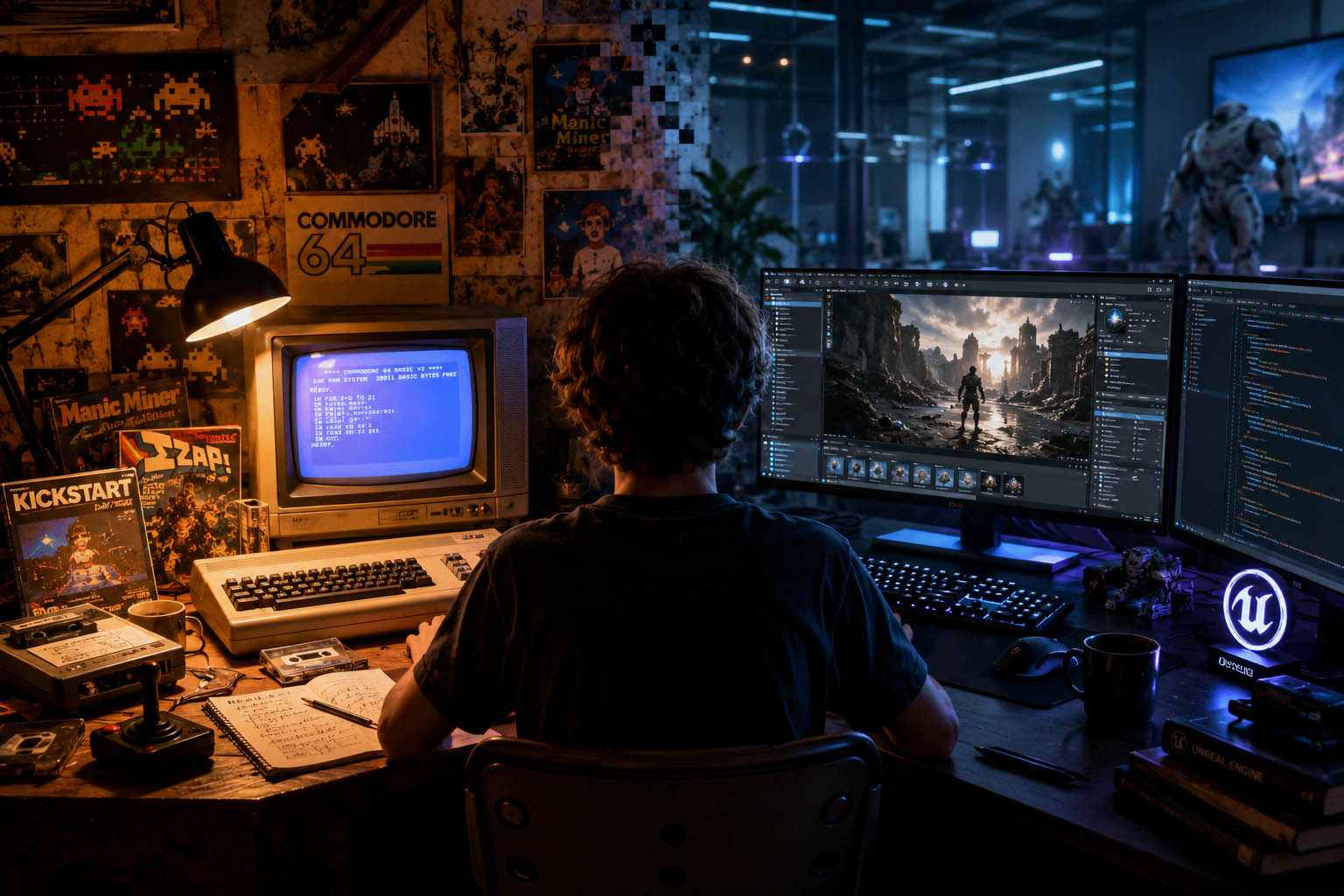
People often assume that those who work in the games industry always had some grand master plan. That we emerged from the womb holding a joystick, started writing rendering engines at age seven, and spent our teenage years methodically preparing for a career creating entertainment for the masses.
Most careers are messier than that.
In my case, it mostly involved cassette tapes, sleep deprivation, and accidentally becoming employable.
Tape Decks And Patience
I grew up during the era of home computers. Strange beige boxes connected to televisions, with enough cables to cause genuine concern. The VIC-20. The C64. The Amiga.
Playing a game back then involved inserting a cassette, typing
LOAD "",1, pressing Play, and waiting. Sometimes five minutes. Often
much longer. Some games took twenty minutes or more to load - developers
eventually started including a loading picture (which itself took a
couple of minutes to appear), and eventually a mini-game you could play
while the main game crawled in from tape.
And yet, somehow, it was magical. Old computers weren't designed to hide how they worked. They practically dared you to poke around inside them. Magazines printed code listings. Games crashed back into BASIC prompts. Memory addresses were discussed in playgrounds as though this was completely normal.
There wasn't much of a wall between playing with the machine and learning how it worked.
Starting Small: Pokes, Cheats, And Breaking Things
I never really decided to become a programmer. It crept up on me.
It started with cheats. POKE commands - little memory addresses you could write directly to give yourself infinite lives, invincibility, or unlimited ammo. Magazines like Zzap!64 and Commodore User published them, and at some point I started submitting my own. Getting your name printed in a magazine because you'd found a cheat code was, genuinely, quite a big deal when you were fourteen.
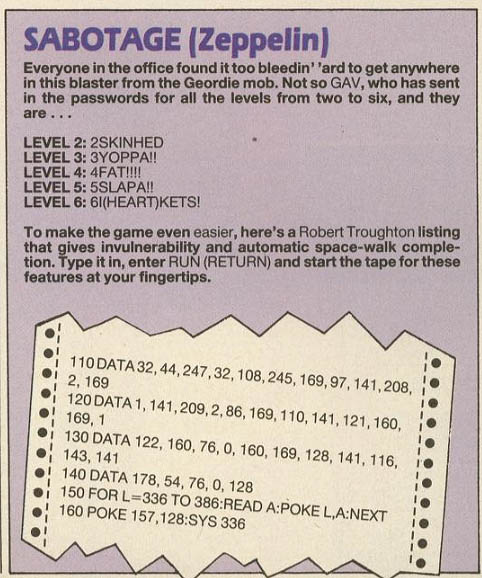
But finding pokes naturally leads to understanding why they work, which leads to reading more. Which leads to typing in the BASIC code listings those same magazines printed - 12 pages long, one missing comma on page seven capable of detonating the entire thing. You'd spend three hours on it only to get a syntax error and have to go hunting. This was considered entertainment in the 1980s.
Gradually, though, you start actually understanding things. Variables. Loops. Memory. Sprites. And then comes the moment that hooks a lot of future developers:
"Wait... I can change things."
You change a colour. Then a score. Then a sprite. Then suddenly you're wading through machine code because you wanted your spaceship to move slightly faster and BASIC wasn't cutting it.
At the time it doesn't feel like learning a marketable skill. You're just trying to make the machine do the thing you want.
The Demoscene
After that came the demoscene.
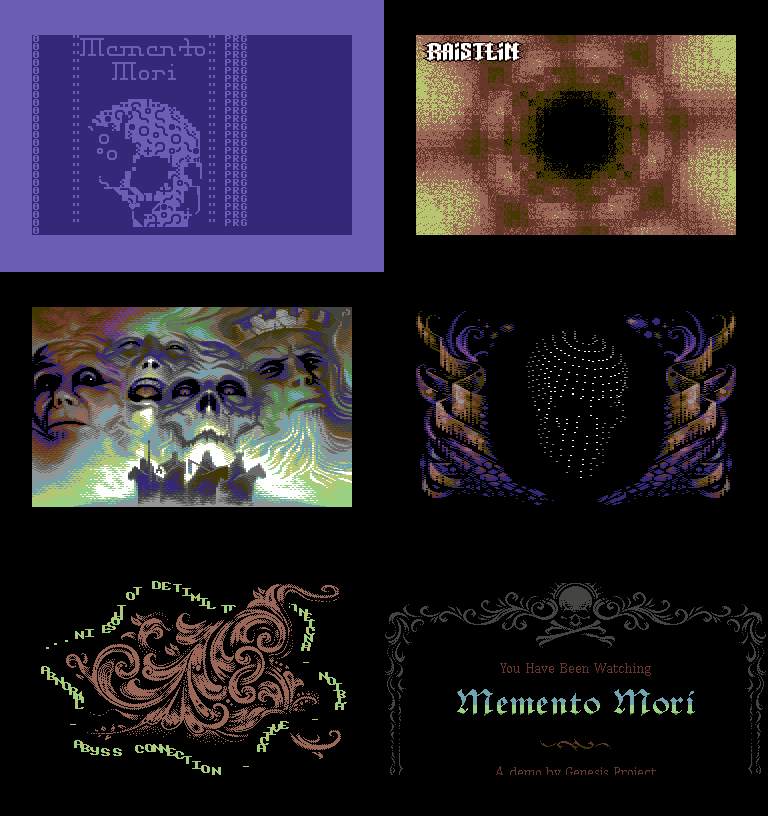
For people who weren't around at the time - the demoscene was essentially thousands of technically obsessed weirdos competing to make computers do things they absolutely should not have been capable of. Scrolling logos. 3D effects. Sprite multiplexers. Music players squeezing sound out of three channels that somehow seemed enormous. Effects that had no business running on hardware with less memory than a modern toaster.
No commercial goal. No monetisation strategy. No engagement metrics. Just people trying to impress each other through code, art and music.
Which, in hindsight, was probably one of the best possible training grounds for game development. You learned optimisation because there was no choice. You learned creativity because the constraints were severe. Coders, artists and musicians all depended on each other - you learned that fast.
You also released things publicly, people judged them - sometimes fairly brutally - and you either improved or stopped.
While I was active in the scene, I also started writing tools - utilities that were genuinely useful to other Commodore users. Commodore Disk User published a good number of them, and featured a couple on their cover. I remember being quietly stunned the first time I saw something I'd written on a magazine cover. I used the money from those to kit out my bedroom pretty thoroughly - big TV, proper hi-fi, surround sound, a sofa. Paradise.
Modern equivalents exist through indie development, modding communities, and now AI-assisted prototyping. The technology has changed enormously. The underlying pattern really hasn't.
My Effort To Become A Proper Adult
Eventually I was expected to do something sensible with my life.
Parents start asking difficult questions like: "So what exactly are you planning to do with your life?"
Fair enough. I went to university, studied mathematics, and started looking at accountancy. Seemed like a sensible plan. Respectable. Stable. Adult.
The problem wasn't really the interviews - it was that accountancy seemed spectacularly dull, and the firms I visited did absolutely nothing to dispel that impression. The offices had the energy of a waiting room. The people seemed to be counting down to something, though it wasn't clear what. It was a highly competitive field, and I couldn't muster any authentic enthusiasm for it, which isn't ideal when you're trying to convince someone to hire you.
I also applied for management training positions at places like McDonald's and was rejected.
Nothing recalibrates your sense of destiny quite like perceiving you're apparently not management material for hamburgers.
At the time it felt disastrous. In hindsight, one of the luckiest things that happened.
The Side Door Into Games
My brother was already working at Reflections. Reflections, for younger readers, was a major UK studio behind games like Destruction Derby & Shadow of the Beast. Getting in back then wasn't really a formal process - you didn't send a CV and wait for HR to call. You expressed interest to the right person, and they looked at what you'd done. Having my brother there already, along with a demoscene background, helped considerably.
I'd resisted for a while. Games didn't feel like a "real" industry back then - rather like a slightly disreputable scene, like joining a travelling circus except with more assembly language.
Eventually, after running out of sensible alternatives, I gave in.
And that was basically it. No grand strategy. No five-year plan. Just:
"Well... I suppose I'll try game development then."
The Shock Of The Early Industry
Something younger developers may not completely appreciate is how small game development teams used to be. Tiny teams building enormous games. Tools were primitive. Engines barely existed in the form anyone thinks of today. A huge amount of the work involved solving problems nobody had solved before.
It wasn't glamorous. We did a few 36+ hour shifts - no joke. At one point, we had 9 months to build an AAA racing game from scratch. Our sole artist accidentally deleted all of his source artwork instead of making a backup. Our boss had to drive from Newcastle to Liverpool to deliver a CD ready to be flown to a US game show - at speeds that were, let's say, ambitious. At one point we rewrote the entire car control and physics system when we were supposed to be nearly finished.
::: warning Nine months to build a AAA racing game from scratch. That's not a war story - that's just what the industry was like. :::
But there was something genuinely exciting about it too. The industry was evolving so fast that everybody was making it up as they went along.
Which, honestly, is still partly true now.
What I Think Matters Now
Looking back, the strangest part is that the path into game development today isn't really that different.
The tools are infinitely better. The barriers are dramatically lower. A teenager now has access to technology more powerful than what entire AAA studios had when I was starting. AI is accelerating things further still - small teams doing things that used to require dozens of people, individuals prototyping faster than ever.
But the thing that gets people noticed hasn't changed.
::: tip Curious people who build things still stand out. That was true when kids were scribbling BASIC listings out of magazines. It's still true now. The technology changes constantly. The mindset doesn't. :::
Final Thoughts
I never planned any of this.
I just kept following the things I found interesting. Computers. Cheats. Code. Demos. Tools. Optimisation. Building weird things because they seemed impossible or because nobody else had bothered yet.
Somehow, after enough of that, I ended up with a career.
And that's one of the better routes into this industry. Not chasing job titles or trends and just building things because you genuinely want to know how they work.
Even if it starts with staring at a loading screen for twenty minutes while a small blocky character runs around collecting coins to keep you from losing your mind.
Comments